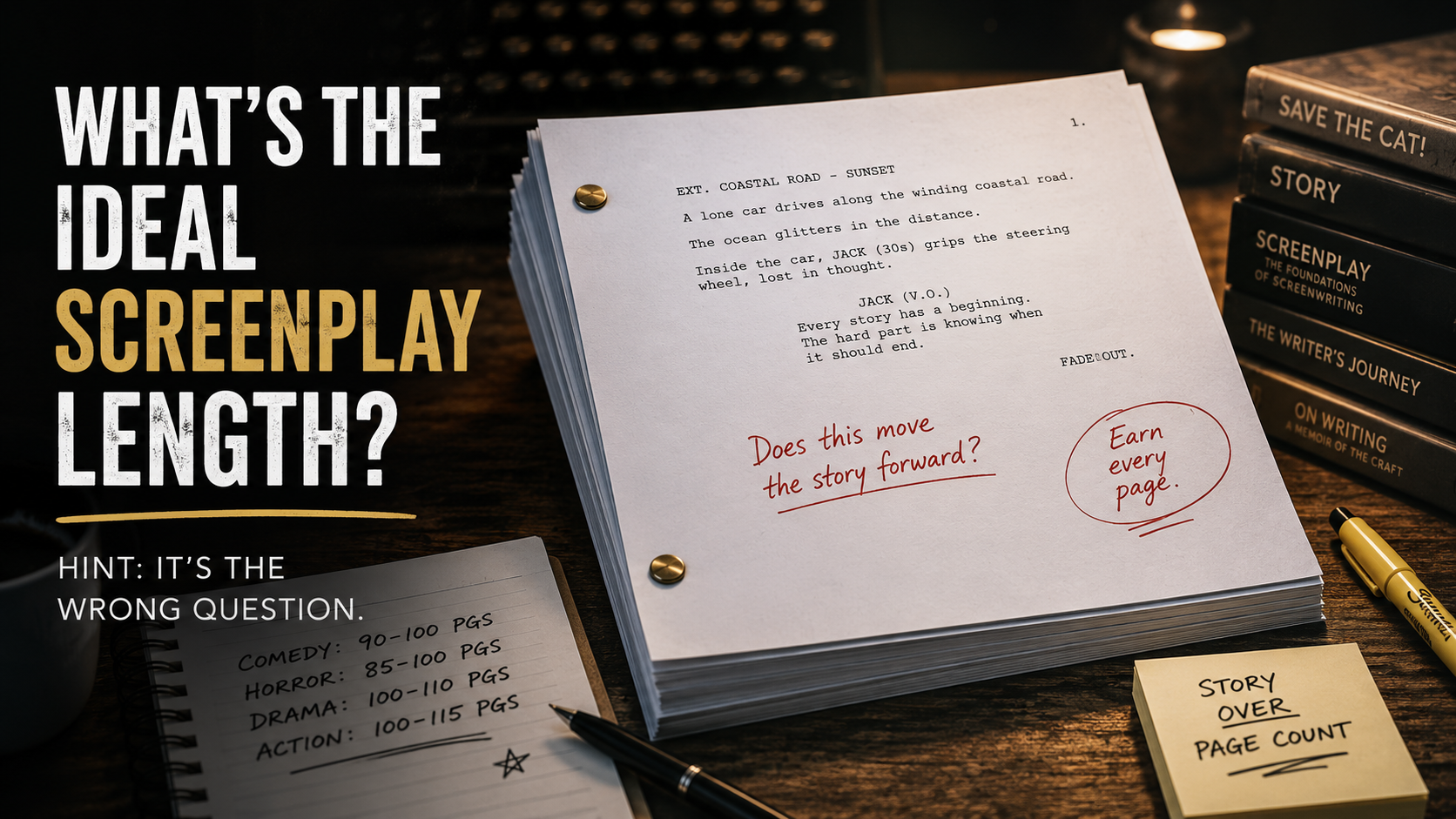
A great screenplay creates momentum. Every scene changes something.
“How long should my screenplay be?”
It’s one of the most common questions new screenwriters ask. Unfortunately, it’s also one of the least useful.
The truth is there isn’t an ideal screenplay length. There is only the ideal length for your story.
That may sound like a cop-out, but bear with me.
The Myth of the 120-Page Script
For years, aspiring writers were taught that a feature screenplay should be around 120 pages because one page roughly equals one minute of screen time. While that rule of thumb still has some value, it has become increasingly misleading.
Modern screenplays are generally leaner. They use more white space, shorter scene descriptions and cleaner formatting than many scripts from the 1980s and 1990s. A 100-page screenplay today may contain almost as much story as an older 120-page script.
As a result, many readers now expect:
- Comedy: 90–100 pages
- Horror: 85–100 pages
- Drama: 100–110 pages
- Action: 100–115 pages
These aren’t rules. They’re expectations. There’s a difference.
The Real Issue Isn’t Length
When someone says, “My script is 145 pages,” the number itself isn’t the problem.
The question is why?
Has the writer earned those extra pages? Is every scene revealing character, advancing the plot or raising the stakes? Or has the story become repetitive?
Likewise, an 80-page screenplay isn’t automatically “tight”. It might simply be underdeveloped.
Length is a symptom, not a diagnosis.
Every Scene Must Earn Its Place
One of the best editing questions you can ask is:
If this scene disappeared, what would the audience lose?
If the answer is “not much”, then the scene probably shouldn’t be there.
Many writers mistake activity for progress. Characters travel, argue, explain and react, yet the story hasn’t actually moved forward.
A great screenplay creates momentum. Every scene changes something.
The Reader’s Perspective
Professional script readers develop instincts surprisingly quickly.
Open a screenplay that’s 95 pages and the assumption is usually that the writer knows how to be economical.
Open one that’s 145 pages and a question naturally arises:
“What couldn’t the writer bear to cut?”
That doesn’t mean long scripts are bad.
It means they have to prove themselves.
Every additional page raises expectations.
But What About Great Long Films?
Of course there are brilliant films with lengthy screenplays.
The difference is that those stories justify their running time.
An established filmmaker may also have earned the confidence of studios and producers in ways an unknown writer hasn’t. Fair or unfair, emerging writers are usually judged more harshly because their screenplay is their audition.
Your first script doesn’t need to demonstrate that you can write 150 pages.
It needs to demonstrate that you know when to stop.
Write Long. Edit Short.
Here’s a piece of advice that sounds contradictory but isn’t.
Write your first draft without obsessing over page count.
Get the story out.
Then become ruthless.
Challenge every line of dialogue. Every description. Every entrance and exit. Every scene.
Ask whether the audience needs this moment or whether *you* simply enjoyed writing it.
There’s an important difference.
The Better Question
Instead of asking,
“How long should my screenplay be?”
Ask,
“How can I tell this story as clearly, economically and powerfully as possible?”
If you answer that question honestly, the page count will usually take care of itself.
After all, audiences don’t leave the cinema talking about how many pages the screenplay was.
They talk about how the story made them feel.
Posted in
by

Acting
Acting
On use
Work here is shared to be read and watched ‐ not reproduced or performed without permission.
Leave a Reply